
Why the Country?
An old dilemma

People have been asking me; “Why the country, David?”
The most shocked are the one’s who know me as the restless, intrepid urbanite who played and sang countless late night gigs for everything from punk, ska and swing bands in three North American cities, reviewed over three hundred contemporary art shows for free weeklies, and could generally be seen at different art openings,
readings, bars, shin-digs and after hours until the wee hours of the morning.
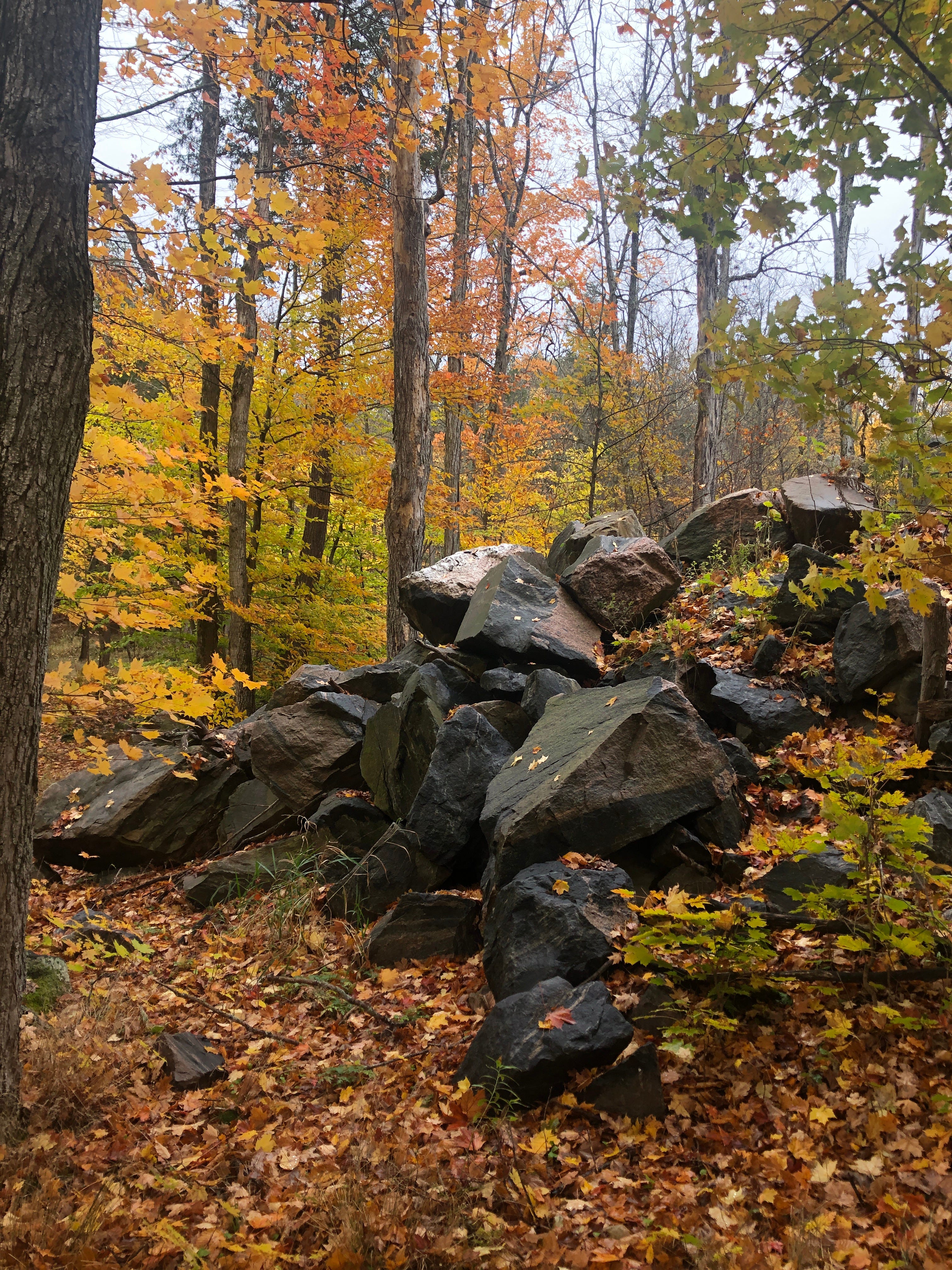
Yet here I am, surrounded by four and a half acres of stately aspen, maple, white birch, jack pine and white and black spruce. Grilling on the porch at night, I hear the weird wild ululations of the loon. Last week my major activities were cleaning the roof gutters for the winter and doing a last pass over the two areas of lawn (meadow, really), clearing away the final blanket of gold and crimson leaves. That, and chopping kindling and hauling logs from the outdoor garage to stack next to our wood burning stove.
When I sit, it’s usually at dawn, which in the winter is thankfully a little later than in summer. If I’m sitting at seven, the stars are still preternaturally bright. Then I watch the sun rise over the lake through my front window (after the cats are fed and the dogs are out).
So why this? I loved the city. I’ve been mulling it over for a while. Let’s start with why I loved the city.
Why I love cities:
It's the people. The sheer density of personalities and the peculiarities they entail. It's why Manhattan remains one of my favorite spots on earth. People eventually give into the madness that comes with being stacked on-top of each-other. The system reaches a tipping point of saturation where things become complex, as opposed to merely complicated. Everything becomes a dense web of stories upon stories upon stories. Bizarre meetings and synchronicities are a regular given. Everything is a funny story accompanied by a funnier saying. As one writer once put it: “New York is like brains continuously having sex.” When I lived there, even the homeless man who frequented my corner was working on a memoir. He was fascinating.
Nor was it overwhelming to me. While cities, New York especially, are known to be loud and frenetic, I never found it so. It was simply drama on a larger scale. I remember returning from a seven day meditation retreat in the Catskills to Times Square and thinking the impossible crowds were strangely harmonious and quiet in their own way.
I found that Toronto, with its odd neurotic insecurities and more brittle British instincts (under which there are oceans of warmth and splendid eccentricity), was a bit more difficult to navigate. It is also less densely packed than scattered, contributing to a diversified sprawl not dissimilar to Los Angeles. Toronto is a vast network of insular community pockets. Even so, I found myself very snug in my west end downtown pocket. I'm sure there are hundreds of Torontos I have not encountered, and I look forward to finding more. Still, it takes just a bit of effort to seek them out, whereas New York just serves up novel pieces of itself relentlessly, inventively, manically, the second you step out. Nothing is stale. You can smell infinity.
I've always been a city boy. I grew up in a mid sized town not unlike London, Ontario, and longed for the time I could escape to San Francisco, where you weren't considered a 'fag' for reading poetry or playing Bach. This was the eighties in small town America. A creeping, stultifying suburbanism and conformity also reigned in a way that many would now find hard to believe. You could be considered ‘weird’ for eating sushi or drinking a Capuccino. I longed for cosmopolitanism, the more extreme the better. A lot of this involved getting to know contemporary art and experimental music, which thrives in large cities. So my life has been a parade of big North American Cities; San Francisco, New York, Montreal, Toronto.
At any rate, the positives of Toronto were definitely on the back-burner because of the pandemic. Everything limited by protocol and a dull pall of paranoia. Public life was obviously curtailed and not a pleasure, as it has been for all of us. When you are stuck in your downtown nest egg, beautiful as it may be, and can't leave, you start to wonder why you are there. When you are stuck there and realize you are also in tremendous debt, you wonder even more so.
What I'm getting at, I think, is that when a cosmopolitan environment provides complications but not complexity, life turns stale. Life in Toronto had become complicated, and very little about it was engagingly complex. I had no sense of participating in a vast unfathomable organism greater than I could comprehend, pulling me into it's own ecology. I sensed a lot of stagnant and frankly badly designed technological and bureaucratic impasses, mostly in the form of usurious taxes, bad park management ( what happened to you Dufferin Grove?) and insultingly absurd traffic snarls. People snarking at each-other passive aggressively because they weren't in 'control'. My kid was afraid to sit on park benches. It was weird, and depressing.
So Why The Country?
There's a tradition of tension between the country and the city, especially for so called ‘literary/artsy/spiritual’ types like myself. The push pull was embodied in Beatnik literature. Japhy Ryder, the plucky, self reliant back-woodsman hero from Kerouac's 'The Dharma Bums' is based on Gary Snyder, who continues to make his mark as a self-reliant, forest dwelling buddhist poet and 'wild man'. At ease in nature, able to drift from one skilled laboring job to another, a bit of a fun loving rogue, fluent in zen, ready for adventure. He's an embodiment of the anti city, anti-establishment ethos that emerged in the late fifties. Get a cabin, read Han Shan and Dogen, chop wood and carry water, look after your cat and dog. Leave the nightmare of 'Moloch' behind. But these self-same beatniks were all about Slim Gaillard, be bop and hard kicks in the big city. It's a love affair that never gets resolved. The city is deliriously engaging, but also full of squalid excesses and dangers. You start snapping your fingers at happenings and end up burned alive in your flannel suit on Madison avenue. This is less likely to happen in the country.
I'm not going to lie and say that this isn't a part of my own cultural leanings. I'm a Northern California boy, after all. I grew up with nature walks and back-packing, Sugar Loaf park and once spent twenty five transformative days in the High Sierra. I remember deer crossing through the forested surroundings of my childhood house ( not dissimilar to my yard now). Maybe this is a return of sorts. Who knows.
Complex, not complicated.
People say that nature is calming because it is simpler than life in the city. I disagree. Nature is calming because it is overwhelmingly intelligent and complex. Your entire body-mind realizes this once it enters into a truly living system, and it is this resonance that results in calm. As one of my current favorite thinkers on my radar, a Daniel Schmactenberger has said "Your house or building is not intelligent. If you burn it down, it won't rebuild itself. A forest is intelligent. If you burn it down, it will rebuild itself."
One of the great lessons I glean from nature is that it is both supremely complex and intelligent. If I am not attuned to this fact, it is because I am not looking closely enough. It's not enough to be simply bowled over by the beauty, I'm gathering books on local forest ecology, geological surveys, indigenous lore, bush craft. I am surrounded by a living intelligent system that has been around for millions of years and hopefully persist long after I'm gone.
Which leads me to the next great lesson: nature doesn't need me. Some people take this particular fact hard, but I think it's important to realize that interdependence means you are part of the complex whole but not essential to it. Not because you’ve ‘failed’ to ‘make it’ in the natural world. No zen mountain hermit ever fretted neurotically in their cave thinking ‘I just don’t think I’ve made enough of a name for myself on this mountain’). But because the natural world is already complete as it is. To take a non-dualist view of it, you are already doing your part in it by simply breathing and being. The greatest favor I could do to the surrounding land is to allow it to be what it already is as fully as possible. Not trammel it with complications. It's oddly reassuring, once you sit with it for awhile. Deeply affirming and deeply humbling, all at once.
So I've learned from the complex environment of cities, and now I'm here to learn from its mirror image in the complexity of nature. It's intensely personal, and I agree it isn't for everyone. It's also funny that due to the nature of creative endeavors I pursue regularly with faint hope, I'm actually on the phone with Manhattan and Toronto everyday. I hear street sounds of my beloved Lower East Side every day, as my partner in creative crime walks around and talks to me. When this Pandemic clears up, I plan to be there more often. To enjoy the highlights and perhaps miss out on the drawbacks.
Meanwhile, I’ll stick around here and try and listen to the silence more.